
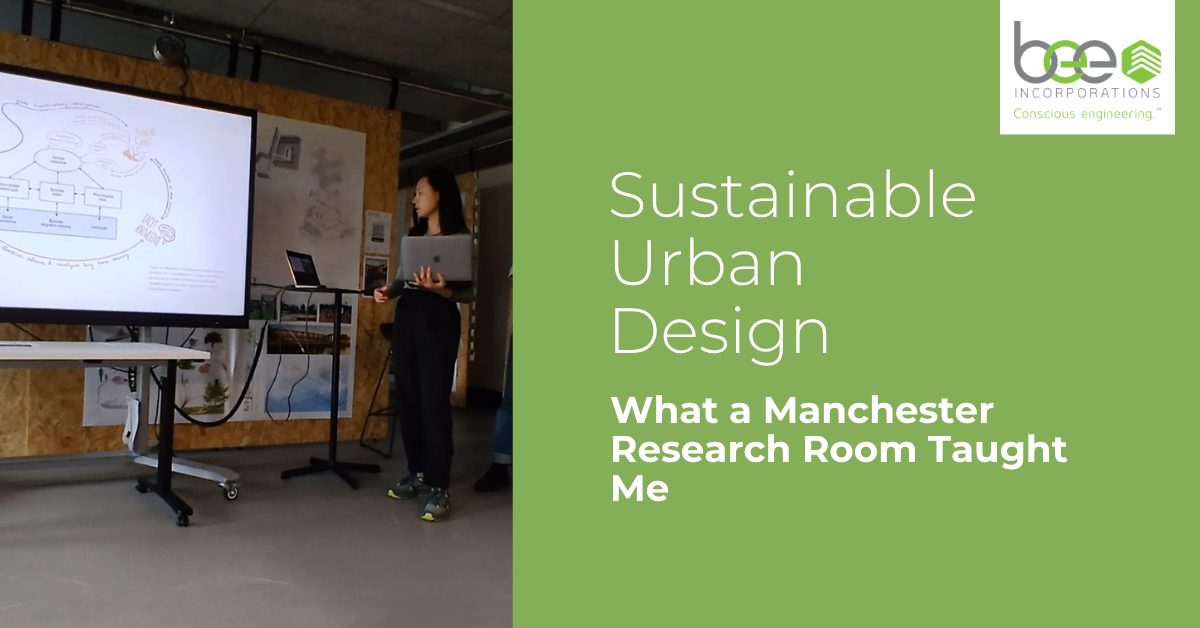
This summer I presented at Livable Cities 2026, the AMPS conference hosted by the University of Salford in Manchester. While I attended the conference as a researcher, I found the conversations and conclusions from the event incredibly valuable to my usual role as a sustainability engineer.
My biggest takeaway was that the strongest case for good sustainable urban design in that room was not a new material or a smart system. It was people: the residents, students, and workers who keep a place alive long after the design team has moved on.
People First · Sustainable Urban Design · BEE Incorporations
Livable Cities is run by AMPS (Architecture, Media, Politics, Society), an interdisciplinary research organisation whose conferences draw delegates from more than 40 countries.
This year’s edition ran as a hybrid event, over 100 people in person and online, under the theme of critiquing the urban renaissance. The session I cared about most was a panel on urban ecologies.
Building a campus commons with students, not for them
I presented work I co-authored, “Wild Campus Commons: Co-creating the University of London Living Lab,” with Blanche Cameron, Emilia Mizielińska, Marius Sidaravicius, Harang Seo, and Hannah Simon.
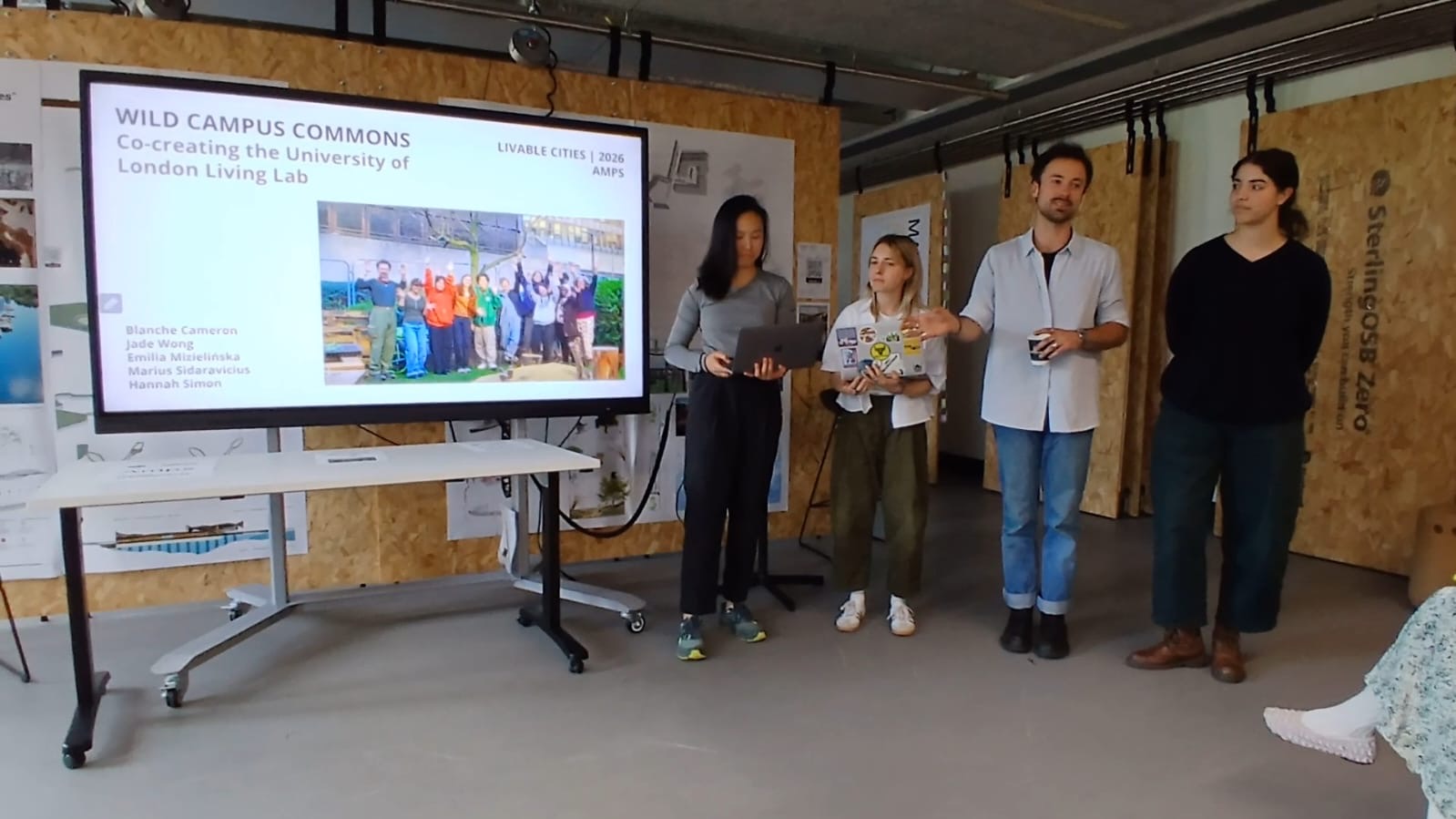
Left to right: Jade Wong, Emilia Mizielińska, Marius Sidaravicius, and Hannah Simon presenting Wild Campus Commons at Livable Cities 2026. Project team members Blanche Cameron and Harang Seo are not pictured.
The short version: students were brought into the design and build of biodiverse habitats on campus as a form of hands-on education. This “living labs” model of stakeholder engagement promotes innovative methods of education and shares knowledge on how to maintain a space more sustianably.
What we got was not only a living lab but a group of people who understood nature-based solutions, material reuse, and long-term monitoring because they had done it with their hands.
That sat alongside Sarah Lavllee’s research on urban foraging and Sarah Crowe’s work on blue-green infrastructure education. A clear consensus formed across all three: physical engagement is what makes urban green space last. Foragers protect the patches they harvest so the crops return. Students who build a habitat tend to maintain it.
The lesson for project teams is blunt. Sustainable features survive when they are tied to something the user base already cares about, which makes maintenance a design problem, not just an operations line item.
Heat is not felt equally
The climate sessions were sobering. Between 2000 and 2019, more than 11,000 extreme weather events caused around 475,000 deaths worldwide, according to the Global Climate Risk Index 2021 (Germanwatch). Heat compounds through the urban heat island effect, and it lands hardest on low-income communities.
I drew a line between Jan Hugo’s meta-analysis of severe heat in South Africa and what I see in Hong Kong. Both have high income inequality and residents in informal housing, spaces that are hard to reach with top-down policy. Heat also hits informal workers, who sit outside most regulation and protection.
With global cooling demand climbing, space cooling is already the fastest-growing energy use in buildings, and the International Energy Agency expects it to roughly double by 2050, the people who cannot afford to cool their homes will carry the heaviest burden.
That is a strong argument for passive design, and for phasing out high-impact refrigerants wherever a building can stay comfortable without them.
Healthy places for ageing cities
Another panel looked at health, care, and accessibility in cities with ageing populations. One US study measured PM2.5 and NO2 in the homes of older adults who cooked on gas stoves, alongside their respiratory symptoms; HEPA air purifiers measurably cut both the pollutants and the symptoms.
It is a useful reminder that indoor air quality is a health outcome, not a comfort setting, which is the kind of thing our BEE Sense monitoring exists to make visible. A separate study in Seoul found that specific sign fonts and colour contrasts made wayfinding easier for older people with failing eyesight.
Small design decisions, real inclusion. Standards like WELL and Access4You are pushing this into the mainstream.
Retrofit over demolition
The session that mapped most directly onto my work was on architectural design. Geraldine Dening compared public housing in Hong Kong and the UK and made the case for retrofitting ageing public estates instead of demolishing them.
Her research shows three things: retrofit is a cost- and carbon-effective way to extend a building’s life; it keeps residents in place and protects the public spaces a community is built around; and because Hong Kong’s public blocks are so standardised, a retrofit strategy that works on one estate can travel to others.
Upon reflection, I believe this logic of prioritising retrofit could also be applied on the rest of the aging housing stock in in Hong Kong, including the Prince Building podium conversion BEE is working on in Central.
Sustainable Urban Design · Manchester · BEE Incorporations
Why a research room matters to a consultancy
Here is what tied it together for me. Every useful idea in that room sat at the intersection of disciplines: ecology and education, engineering and equity, architecture and public health. None of them belonged to a single profession.
That is the case for how a consultancy like BEE is built, with architects, planners, environmental scientists, and engineers in the same team, so a project can be solved from the technical and the social side at once.
Research like the work presented in Manchester is where those two sides get tested before they reach a client’s site.
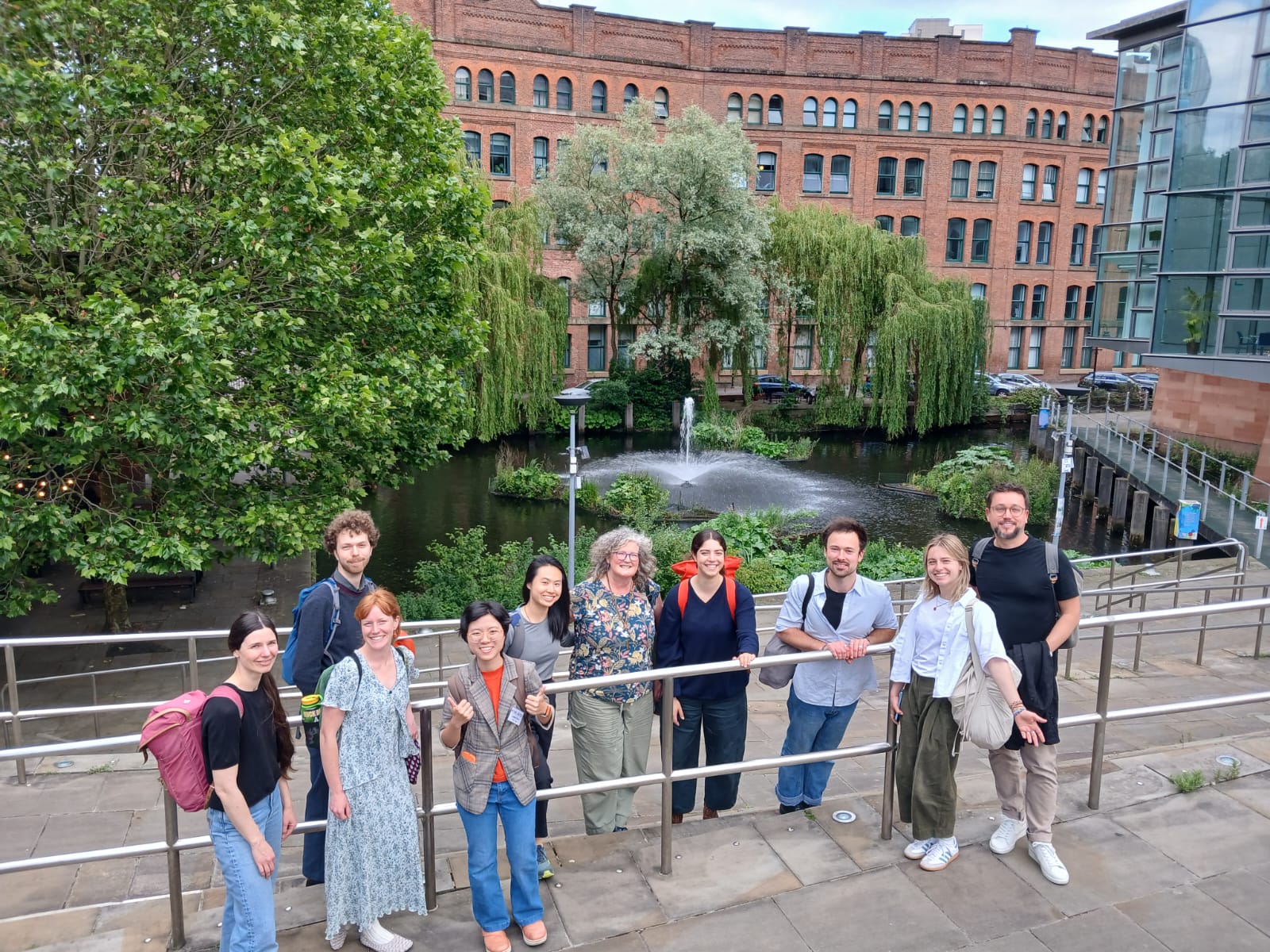
Livable Cities 2026 delegates at the University of Salford, Manchester. From third from left: Sarah Lavllee, Yi-Hsuan Wang, Jade Wong, Blanche Cameron, Hannah Simon, Marius Sidaravicius, and Emilia Mizielińska.
About AMPS
Architecture, Media, Politics, Society (AMPS) is an international, interdisciplinary research organisation. Its global conferences attract delegates from over 40 countries, it partners with several academic publishing houses, and its open-access journal, Architecture_MPS, has published since 2011.
The 2026 Livable Cities conference was held in collaboration with the University of Salford in Manchester.
I came home convinced that the gap is not knowledge. The research exists. The gap is getting it from a conference room into a project programme.
”“The best ideas in that room came from people working across disciplines. That's how I think sustainability has to be delivered on real projects: technical and social perspectives considered in parallel.”
Jade WongSustainability Project Engineer, BEE Incorporations
That is the work I am bringing back to BEE.
About BEE Incorporations — Founded in 2009 by Alessandro Bisagni, BEE Incorporations is a global green building consultancy headquartered in Hong Kong and Shanghai. The firm operates 15 offices across four continents, specialising in green building certifications (LEED, WELL, RESET, BEAM Plus), ESG advisory, performance testing, and the BEE Sense IAQ and energy monitoring platform.
Special thanks to JC-Ray H. Bellen, Marketing and Communications Associate, BEE Incorporations, for their editorial review and suggestions on this piece.